
DAILY OUTFITTER BLOG
Lining Fabric for Pakistani Suits: How to Choose
By Daily Outfitter · · Updated
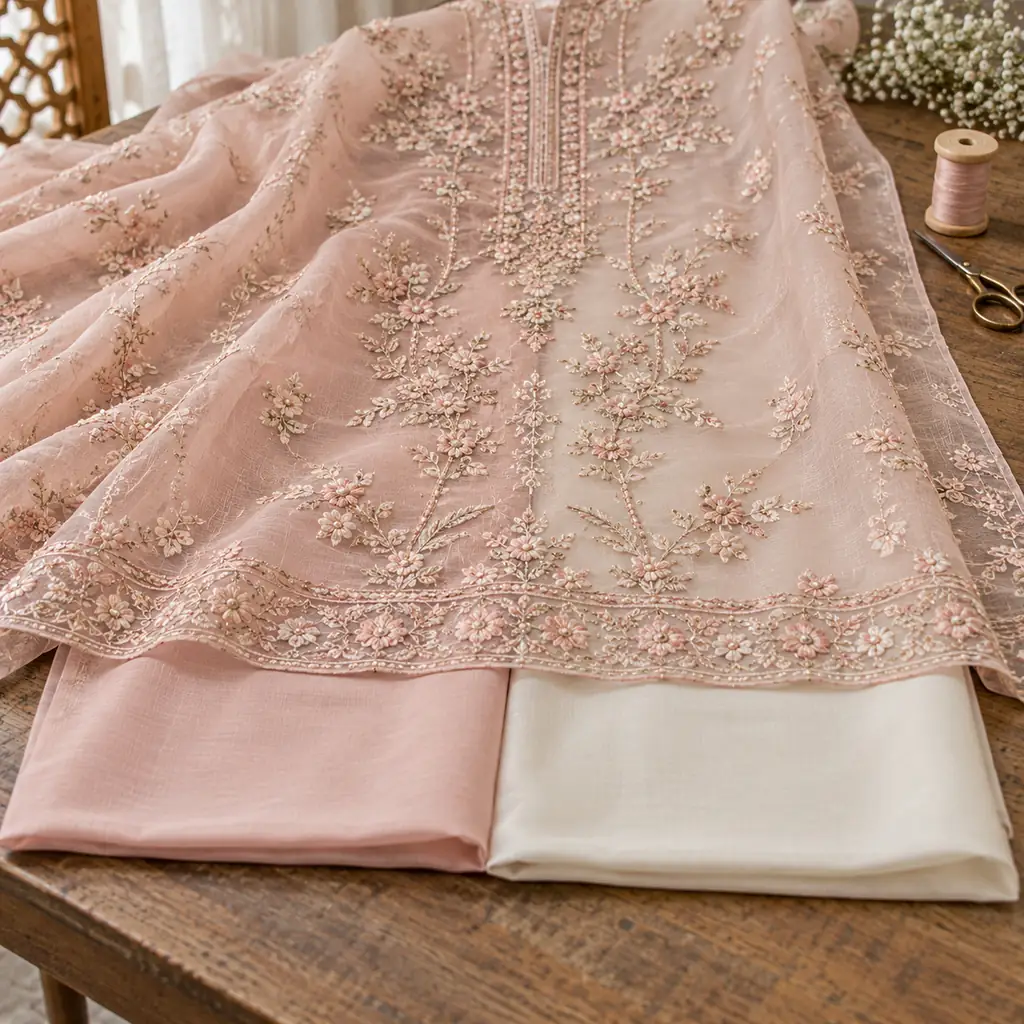
Choose lining fabric for Pakistani suits by testing it with the actual outer fabric. Check coverage, colour, movement, comfort and compatible cleaning instructions before the tailor cuts either layer. There is no single lining material that is best for every lawn, chiffon or embroidered kameez.
When people ask a tailor for “lining” or an “inner,” they may mean different constructions. Explain whether you want extra coverage, a separate inner garment or support for the outer fabric. That conversation matters as much as the material you buy.
First decide what the inner layer needs to do
Write down the problem you want to solve. Is the shirt too sheer for your preference? Does a pale fabric show seam allowances? Do you want an inner layer you can remove, or a completed garment with an enclosed inside?
A useful brief might be: “I want the front and back covered, sleeves left as shown, and enough room to sit comfortably.” Another buyer may prefer lined sleeves or a separate slip. Neither plan should be assumed from a model photograph.
Lining, underlining and a separate inner are different
| Construction | What it means | What to discuss |
|---|---|---|
| Lining | A separate inner unit attached inside the garment | Where it is attached and how the inside is finished |
| Underlining | A backing joined to corresponding outer pieces during construction | How it changes the outer fabric's behaviour and appearance |
| Separate inner or slip | An independent garment worn underneath | Its length, neckline and compatibility with other outfits |
New Mexico State University's sewing guide explains the construction distinction. Ask your tailor which approach suits the fabric and final cut rather than using the terms interchangeably.
A sample test is better than choosing from the lining roll alone
Take a small outer-fabric sample, where one is available, and place it over the proposed lining. View the layers in daylight and ordinary indoor light. Check the appearance over both light and dark backgrounds if coverage is important to you.
Then let the two fabrics hang together over your hand. Do they produce the outline you want? Does the inner layer dominate a fabric you wanted to keep soft? Seamwork's underlining tutorial recommends evaluating fabric combinations together; the finished effect depends on the pair, not just the name on either roll.
Which lining options should you compare?
Ask the fabric seller or tailor to identify the material rather than accepting “good lining” as a complete description. The following are discussion points, not guarantees about every fabric sold under those names.
| Candidate | What to check with your outer fabric |
|---|---|
| Light cotton lawn, voile or similar cotton fabric | Coverage, bulk, surface feel and whether the combined drape suits the cut |
| Viscose or cupro lining | The documented composition, handling, colour and care instructions |
| Polyester or another synthetic lining | Your comfort preference, fabric weight and the care requirements of the finished outfit |
| A lining described only by finish or trade name | The underlying fibre information and how the actual sample behaves |
A smooth-looking material is not automatically the right choice for a garment worn close to the body. Ask to handle a sample and consider your own preferences. Do not select lining solely because it is the cheapest available option or because it looks shiny.
For chiffon or another sheer outer fabric
Decide the intended coverage before choosing the neckline, sleeve finish and shirt length. Check whether the lining edge will be visible through the outer layer. A colour-matched sample may preserve the intended shade, while another colour may change it; compare the layers rather than assuming.
Confirm whether the product includes an inner fabric at all. A three-piece suit generally refers to the shirt, trouser and dupatta, not an additional lining. Ask the seller about any separate components shown in the styling.
For lawn or an embroidered kameez
Not every lawn shirt needs full lining. Assess the actual fabric, embroidery openings and your coverage preferences. Ask whether selected areas need support instead of adding an inner layer everywhere by default.
Check neckline and sleeve plans before cutting through embroidered panels. Our kameez neckline guide and sleeve design guide can help you prepare the style brief.
Agree on care and fit before stitching
Ask whether the outer fabric, lining and decorative elements can follow the same finished-garment care method. If pre-treatment is appropriate, let the fabric instructions and tailor's advice determine the process; do not automatically soak an embellished set.
At a trial fitting, sit down and move your arms. Check whether the inner layer pulls, shows where you did not intend or restricts the outer garment. Changes are easier to discuss before the final finishing.
When comparing three-piece embroidered suits, save the component description and show it to your tailor. For further planning, read our unstitched versus stitched suit guide.
Frequently asked questions
What is the best lining for a chiffon suit?
Choose after testing the actual outer fabric with candidate linings. Coverage, drape, colour, comfort and care need to work together; a single material is not best for every chiffon-labelled fabric.
Is lining included in every three-piece suit?
No. Check the itemised listing. Do not assume shirt, trouser and dupatta also include a separate inner or lining fabric.
Should the lining be exactly the same colour?
Not always, but view the layered result before deciding. A different lining colour can change the appearance of a sheer fabric.
Sources
Construction and compatibility references: New Mexico State University, Selecting Interfacings, Underlinings, and Linings; Seamwork, How to Sew an Underlining. Pakistani suit examples and fitting questions are Daily Outfitter's editorial applications. Checked 18 October 2026.
Feature image: AI-generated editorial illustration for this guide. Garments, fabrics and labels shown are illustrative examples.