
DAILY OUTFITTER BLOG
Chiffon vs Organza Dupatta: Which Should You Choose?
By Daily Outfitter · · Updated
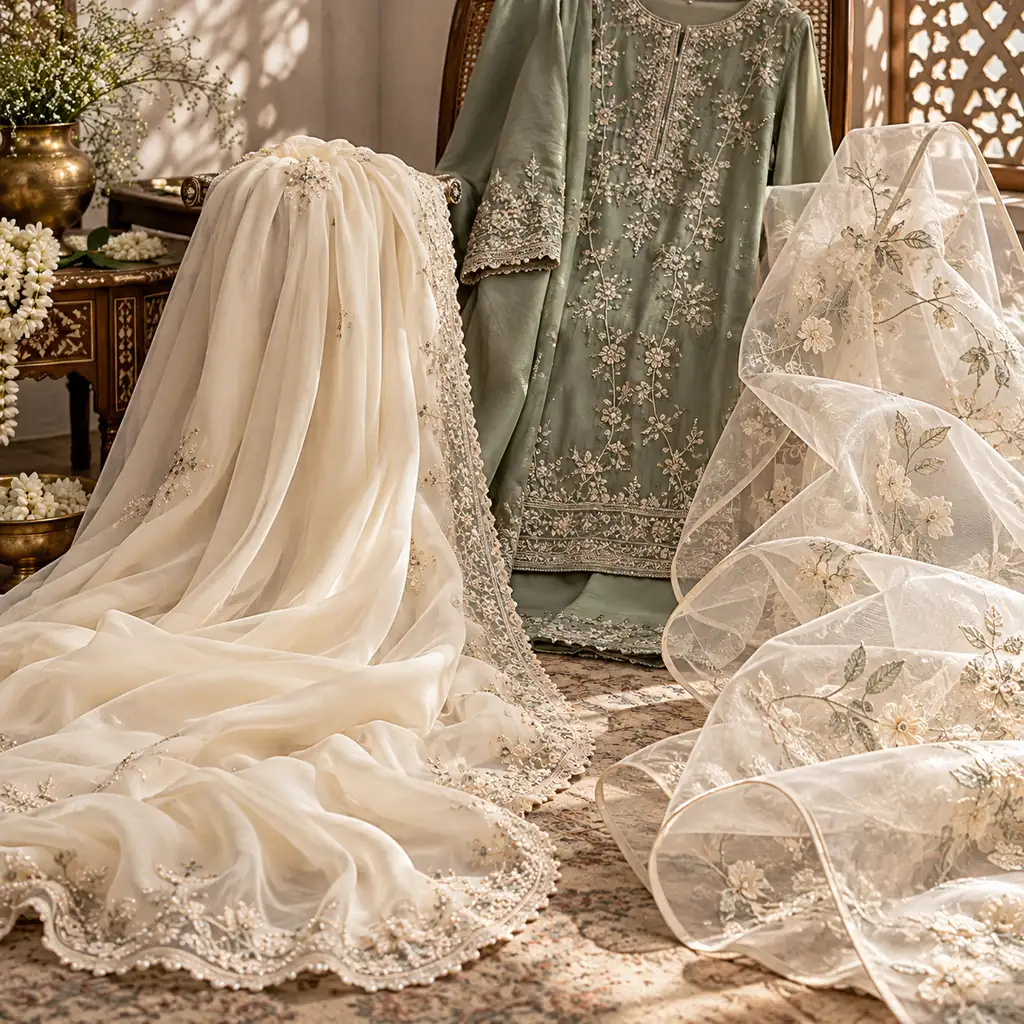
Choose chiffon when you prefer a softly falling dupatta; consider organza when you want a more defined outline and visible structure. Both can be sheer. The actual weave, blend, embroidery and border weight matter more than the fabric name alone.
Start with the drape you want
Chiffon usually moves in softer folds, while organza tends to hold a clearer shape. That difference changes how a dupatta sits over the shoulders and how much volume it adds around an embroidered shirt. Touch and drape the actual piece whenever possible, especially if it has a heavy border.
Current festive collections include both blended chiffon and organza dupatta options. This is a practical comparison for choosing between them, not a claim that either fabric is better quality in every suit.
Chiffon and organza at a glance
| Decision | Chiffon dupatta | Organza dupatta |
|---|---|---|
| Typical drape | Soft, flowing folds | More structured folds |
| Visual outline | Often less bulky | Can frame borders more distinctly |
| Coverage | Often sheer; check the actual piece | Often sheer; check the actual piece |
| Styling starting point | Long, relaxed shoulder fall | Deliberate folds with border visible |
| Main practical check | Slipping and heavy-border pull | Stiffness and how the edge sits |
When chiffon may suit your outfit
Try chiffon when your shirt already has noticeable embroidery and you want the dupatta to sit quietly beside it. A relaxed shoulder drape can keep the neckline visible without creating a second large focal point. Chiffon can also be convenient when you want to gather the fabric into smaller folds.
Check whether it slides on your shirt or lining. A discreet pin may help, but place it through a stable area and test carefully to avoid pulls. An embroidered border can make even a light dupatta feel heavier at one edge, so practise your arrangement before the event.
When organza may suit your outfit
Try organza when the dupatta border is an important part of the design. Its more defined outline can make a plain or lightly embroidered shirt feel dressed up. Fold it deliberately so the edge sits where you want it rather than expecting it to collapse like a soft scarf.
Check how the fabric feels against your neck and arms. Different organzas have different stiffness, and a photograph will not tell you everything. If comfort around the face matters, ask whether a close-up or drape video is available.
Coverage and comfort: questions to ask before buying
- Is the dupatta chiffon, organza or a stated blend?
- What are its dimensions and does the whole border appear in the photos?
- Is it sheer when held against light?
- Does embroidery cover the centre or only the edges?
- Are there extra patches or borders that require finishing?
- What are the seller's specific care instructions?
Neither chiffon nor organza automatically provides opaque coverage. If you need more coverage, compare a lawn or another less sheer dupatta, or plan a suitable arrangement with your tailor. Do not assume a three-piece set uses the same fabric for every component.
Match the dupatta to the shirt's detail
For a heavily embroidered neckline, start with the dupatta on one shoulder and check the result in a mirror. For a quieter shirt, show more of the border across both shoulders. With a strong printed outfit, repeat one existing colour instead of adding several new ones.
Let comfort decide the final drape: walk, sit and move your arms. Our dupatta styling guide offers arrangements you can adapt to either fabric. For complete sets, compare the actual component descriptions in 3-piece embroidered suits and 3-piece printed suits.
Care without guessing
Follow the label or the seller's instructions for that exact piece. Fibre blends, metallic threads, glued details and embroidery can change the permitted cleaning and pressing method. Avoid pulling a snag or pressing raised embellishment directly. If instructions are missing, ask before washing or applying heat.
For storage, support delicate work and avoid catching the border on rough jewellery or bag hardware. Read our embroidered suit care guide alongside the specific label.
Research notes
Reviewed on 13 October 2026: festive collection lists chiffon and organza dupatta categories. The comparison is a general styling guide; individual fabrics vary. The feature image is an AI-generated illustration, not a photographed product sample.
Frequently asked questions
Which dupatta is better for everyday wear?
Choose the piece that feels comfortable and stays secure in your preferred drape. A soft chiffon may appeal to you, but border weight and care requirements still matter.
Is organza always more expensive than chiffon?
No. Fibre, embroidery, finishing, dimensions and the seller's pricing affect cost. Compare complete product details rather than fabric names alone.
Can I wash both fabrics in the same way?
Do not assume that. Check the specific instructions for each dupatta, particularly when it has embellishments or a different fibre blend.