


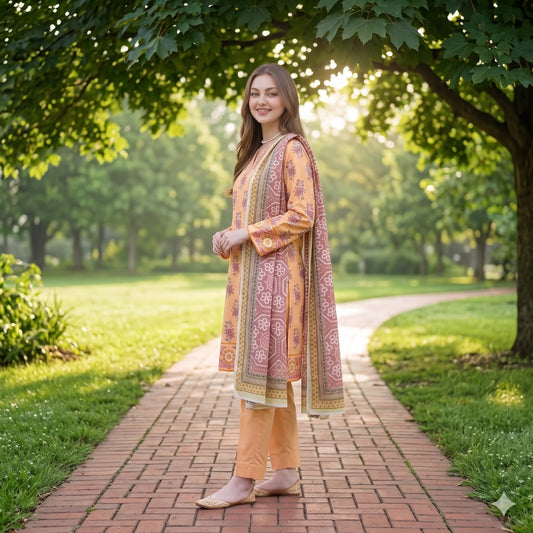

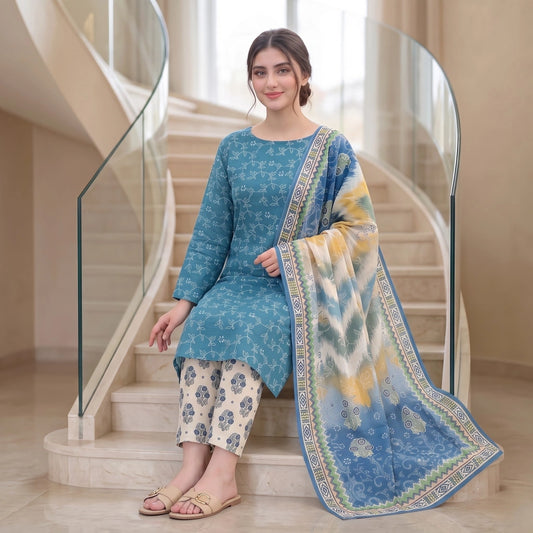

Lawn Suit Price in Pakistan 2026: What You Actually Get at Every Budget
Ask what a lawn suit should cost in Pakistan and you'll get answers ranging from Rs. 1,500 to Rs. 25,000 — for what looks, in a photograph, like the same thing.
It isn't the same thing. But the difference is rarely visible on a screen, which is exactly why so many people feel cheated after a purchase.
This guide breaks down what you actually receive at each price band in 2026, the six factors that genuinely move the price, and the stitching cost most people forget to add.
The short answer: A decent 3-piece unstitched printed lawn suit in Pakistan sits around Rs. 3,000–4,000 in 2026. Embroidered runs Rs. 4,000–6,000. Chikankari and fancy lawn Rs. 6,000–8,000. Hand-embroidered party wear Rs. 8,000–12,000. Anything below Rs. 2,500 involves a real compromise somewhere — usually the dupatta.
The six things that actually drive the price
Before the bands, it helps to know what you're paying for. Almost the entire price difference between two lawn suits comes down to these:
1. Fabric weight and quality
Lawn is measured in threads per inch and grams per square metre. Finer, denser lawn drapes better, holds colour longer and doesn't go transparent after three washes. It also costs more per metre. This is the single biggest cost input and the hardest to judge from a photo.
2. Print method
Rotary and screen printing are cheap and fast, with a limited colour range and visible repeats. Digital printing handles fine detail, gradients and photographic florals — and costs noticeably more per metre. If a print has soft shading rather than flat blocks of colour, you're looking at digital.
3. Embroidery: machine, schiffli, or hand
This is where prices jump. Machine embroidery is quick and cheap. Schiffli sits in the middle. Genuine hand embroidery — real chikankari, applique, hand-set stones — involves days of labour per suit, and the price reflects it. A great deal of what's sold as "chikankari" in Pakistan is machine work.
4. The dupatta
The most common place to cut corners. A cheap suit gives you a thin, same-fabric dupatta. A better one gives you chiffon, organza, or a properly finished lawn dupatta with a woven or embroidered border. Check the dupatta fabric before anything else — it tells you more about a suit's real quality than the kameez does.
5. What's in the "3-piece"
A proper 3-piece is kameez, shalwar and dupatta with full, usable metreage — generally around 2.5m for the kameez, 2–2.5m shalwar, 2.5m dupatta. Some cheap suits shave half a metre off, which you only discover when your tailor tells you the kameez has to be shorter than you wanted.
6. Brand markup
Retail floor space, advertising, celebrity campaigns and seasonal launches all sit inside the sticker price. Two suits from the same mill can differ by Rs. 4,000 purely on the label.
Lawn suit prices in Pakistan 2026: band by band
Under Rs. 2,500 — expect a compromise
At this price something has been cut. Usually it's the dupatta — thin, short, or matching-fabric rather than a proper contrast piece. Sometimes it's the metreage. Sometimes it's last season's unsold stock, which is genuinely fine if you like the print.
Reasonable for: Everyday home wear, a second suit in a colour you're unsure about.
Watch for: Total fabric under 5.5 metres, and "3-piece" listings that turn out to be 2-piece.
Rs. 2,500–4,000 — the honest everyday band

This is where most of Pakistan actually shops, and where the value is best. Expect good-quality digital printed lawn, full 3-piece metreage, and a dupatta you'd be happy to wear.
For reference, digital printed 3-piece suits at Daily Outfitter start around Rs. 3,420 — for example the Toffee Bandhani and Sage Cross suits.
Reasonable for: Daily wear, office, university, a suit you'll wear twenty times.
Should include: Full metreage, digital or good rotary print, contrast or bordered dupatta.
Rs. 4,000–6,000 — embroidered lawn

Now you're paying for embroidery — typically an embroidered front panel, sometimes sleeves and a border. The base fabric should also be a step up from the previous band.
Embroidered 3-piece suits like the Deep Teal Floral and Emerald Floral start at Rs. 3,969, which sits at the low end of this band.
Reasonable for: Eid, family functions, anywhere you want to look dressed up without being formal.
Ask: Is the embroidery on the fabric or on a separate patch stitched on? A separate patch is cheaper to produce.
Rs. 6,000–8,000 — fancy lawn and chikankari

Chikankari work, laser-cut hems, mixed techniques on one piece. The finishing is the difference here — clean edges, no loose threads on the reverse, embroidery that sits flat rather than puckering the fabric.
The Fancy Lawn collection sits at Rs. 6,370 for chikankari suits with laser-cut hems.
Reasonable for: Eid, mehndi guest, a suit you want to keep for years.
Watch for: "Chikankari" that's actually machine-run. Real hand chikankari has slight irregularity between motifs; machine work is identical every repeat.
Rs. 8,000–12,000 — hand-embroidered party wear

Genuine hand embroidery, stone and sequin work, and a chiffon or organza dupatta rather than lawn. This is days of labour per suit, and it's the band where the price is most clearly justified by what's in front of you.
Hand-embroidered party suits with chiffon dupattas in the Party Wear collection run from about Rs. 8,999.
Reasonable for: Weddings, Eid, formal evening events.
Check: Turn the fabric over in the photos if the seller provides them. Hand embroidery has a neat, deliberate reverse; heavy glue or backing fabric is a shortcut.
Rs. 12,000 and above — designer and brand territory
Above roughly Rs. 12,000 you're generally paying for design, exclusivity and the label. That can be entirely worth it — an original print you won't see on three other women at the same wedding has real value. Just be clear that you're buying design rather than materially better fabric.
The cost everyone forgets: stitching
An unstitched suit is not the final price. Add your tailor.
| Stitching type | Typical range (2026) |
|---|---|
| Simple kameez shalwar, local tailor | Rs. 1,200 – 2,500 |
| With lining, piping or pintucks | Rs. 2,000 – 3,500 |
| Boutique or designer stitching | Rs. 4,000 – 8,000+ |
| Party wear with heavy embroidery | Rs. 3,000 – 7,000 |
Rates vary considerably by city and tailor, and rise sharply in the two weeks before Eid and 14 August. Treat these as a planning estimate, not a quote.
So a Rs. 3,500 printed lawn suit realistically lands around Rs. 5,000–6,000 once worn. Budget for the whole number, not the fabric price.
Five signs you're overpaying
- The discount is permanent. A suit that has been "50% off" every day for six months was never the higher price.
- The dupatta isn't shown separately. If every photo is styled so the dupatta is barely visible, there's usually a reason.
- No fabric detail anywhere. A seller confident in their fabric will tell you the metreage, the print method and the dupatta material. Silence on all three is a signal.
- "Hand embroidery" at a machine price. Genuine hand work below roughly Rs. 6,000 for a full suit is very unlikely. Labour costs what it costs.
- Photos that are clearly not of that suit. Stock imagery, mismatched crops, or a model shot that doesn't match the flat-lay colour.
What about men's fabric?
Men's pricing is simpler because there's less variation. A 4-metre cutting piece of good wash and wear runs roughly Rs. 2,000–3,500 in 2026, with premium boski and blended fabrics above that. Stitching a shalwar kameez typically costs Rs. 1,500–3,000 depending on city and finish.
Daily Outfitter's Wash & Wear collection sits at Rs. 2,420 for a 4-metre piece.
Why online is often cheaper than the market
Not always — but usually, and for an unglamorous reason: no shop rent, no salesmen, no sunk cost in a prime-location lease. A store operating online passes some of that back in price.
The trade-off is that you can't feel the fabric. Which means the things that protect you are: honest photographs, stated metreage, cash on delivery so you're not paying in advance, and a seller who answers questions before you order rather than after.
Frequently asked questions
What is the average price of a lawn suit in Pakistan?
For a 3-piece unstitched printed lawn suit in 2026, roughly Rs. 3,000–4,000 is the realistic middle of the market. Embroidered suits sit around Rs. 4,000–6,000, and hand-embroidered party wear from Rs. 8,000 upwards.
Why are some lawn suits so expensive?
Three reasons, in order of impact: genuine hand embroidery, which is days of labour per suit; higher-grade base fabric and digital printing; and brand markup covering retail space and advertising. The first two you can see and feel. The third you can't.
Is unstitched cheaper than stitched?
The fabric costs less, but you then pay a tailor, so the total is often similar. What you gain is fit — a stitched suit is cut to standard sizing, while an unstitched one is cut to you. For most people that's worth the extra step.
How much fabric is in a 3-piece lawn suit?
Around 7–7.5 metres total is standard: roughly 2.5m kameez, 2–2.5m shalwar, 2.5m dupatta. If a listing doesn't state metreage, ask before ordering — short-cut suits are the most common quiet compromise.
Are cheap lawn suits worth buying?
For everyday home wear, often yes. For anything you'll be photographed in or want to keep for several seasons, the Rs. 3,000–4,000 band is where the quality curve steepens sharply. Below Rs. 2,500 you're usually paying for one summer.
Shop by budget
If you want to see the bands rather than read about them:
- Printed Lawn — 3-piece digital printed suits from Rs. 3,420
- Printed & Embroidered — embroidered 3-piece suits from Rs. 3,969
- Fancy Lawn — chikankari and laser-cut work from Rs. 6,370
- Party Wear — hand-embroidered with chiffon dupatta from Rs. 8,999
- Wash & Wear for men — 4-metre pieces at Rs. 2,420
Cash on delivery across Pakistan. Questions about fabric or metreage before you order — WhatsApp +92 300 9520579.
Related reading: Chikankari Lawn: What It Is and What a Fair Price Looks Like · How to Choose the Perfect Unstitched Lawn Suit · Lawn vs Cambric vs Wash & Wear